Ask a facility manager how they pick a floor scrubber, or a farm how it chooses a weeding robot, and the answer is rarely a catalogue. It is vendor PDFs, a sales call, and a handful of generated price pages that disagree with each other. The machines are real; the market around them is not yet.
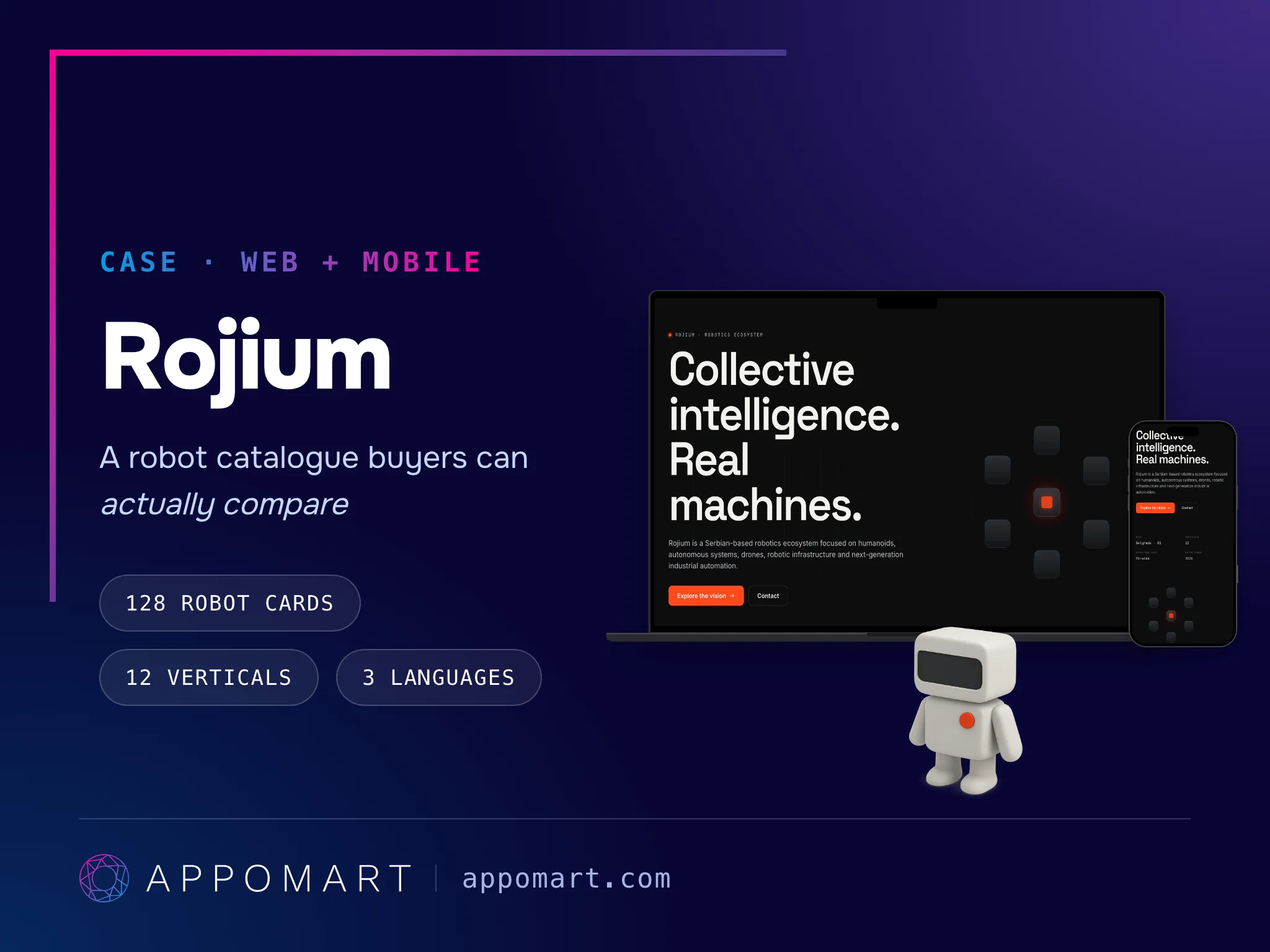
Rojium is our answer to that gap: a robotics showcase for the European market, built by Appomart and live at rojium.com.
What Rojium is
A catalogue of 128 robot cards across 12 verticals — commercial cleaning, mowers, agriculture, construction, humanoids, quadrupeds, prosthetics, exoskeletons, warehouse, aviation, robotaxis and autonomous add-ons. Each card carries specifications taken from the vendor, with a named source, and the machine class it belongs to.
Next to the catalogue sits a blog that explains the market rather than announcing it: what the EU rules of origin mean for a Chinese robot with a European badge, what a weapons policy on paper is worth, why a stock swing is not a buying signal.
Why the cards show sources and not prices
The easiest way to make a robot catalogue look complete is to fill the price column. We did the opposite: prices stay request-only until regional terms are verified.
The reason is practical. Search results for "robot price" are dominated by generated listings whose numbers contradict each other and lead nowhere. A buyer who takes one of those figures into a procurement meeting loses credibility, and so does the catalogue that supplied it. Fewer numbers, each traceable, is worth more than a full table nobody can defend.
Three languages, one card
Rojium ships in English, Serbian Latin and Serbian Cyrillic. That is not three translations of a landing page: every robot card, filter and specification label reads correctly in all three, and the Cyrillic version is a first-class locale rather than a transliteration.
For a regional market this is the difference between a site that serves its audience and one that merely covers it.
Built on our own core
The showcase, the blog and the catalogue run on one engine — the whitelabel core we develop in-house. A new vertical, a new language or a new content block arrives as a configuration, not as a rebuild, and improvements made for one project reach the others.
That is also why the project could start with content instead of infrastructure: the first weeks went into research of real machines and their sources, not into assembling a stack.
What we are watching next
The catalogue is the foundation, not the product. The work ahead is comparison: putting machines of one class side by side on the parameters a buyer actually decides on — cost of ownership, service reach, certification, and what happens when a vendor leaves the market.
If you are choosing a robot for a real site and cannot find a straight answer, that is exactly the problem we are working on.