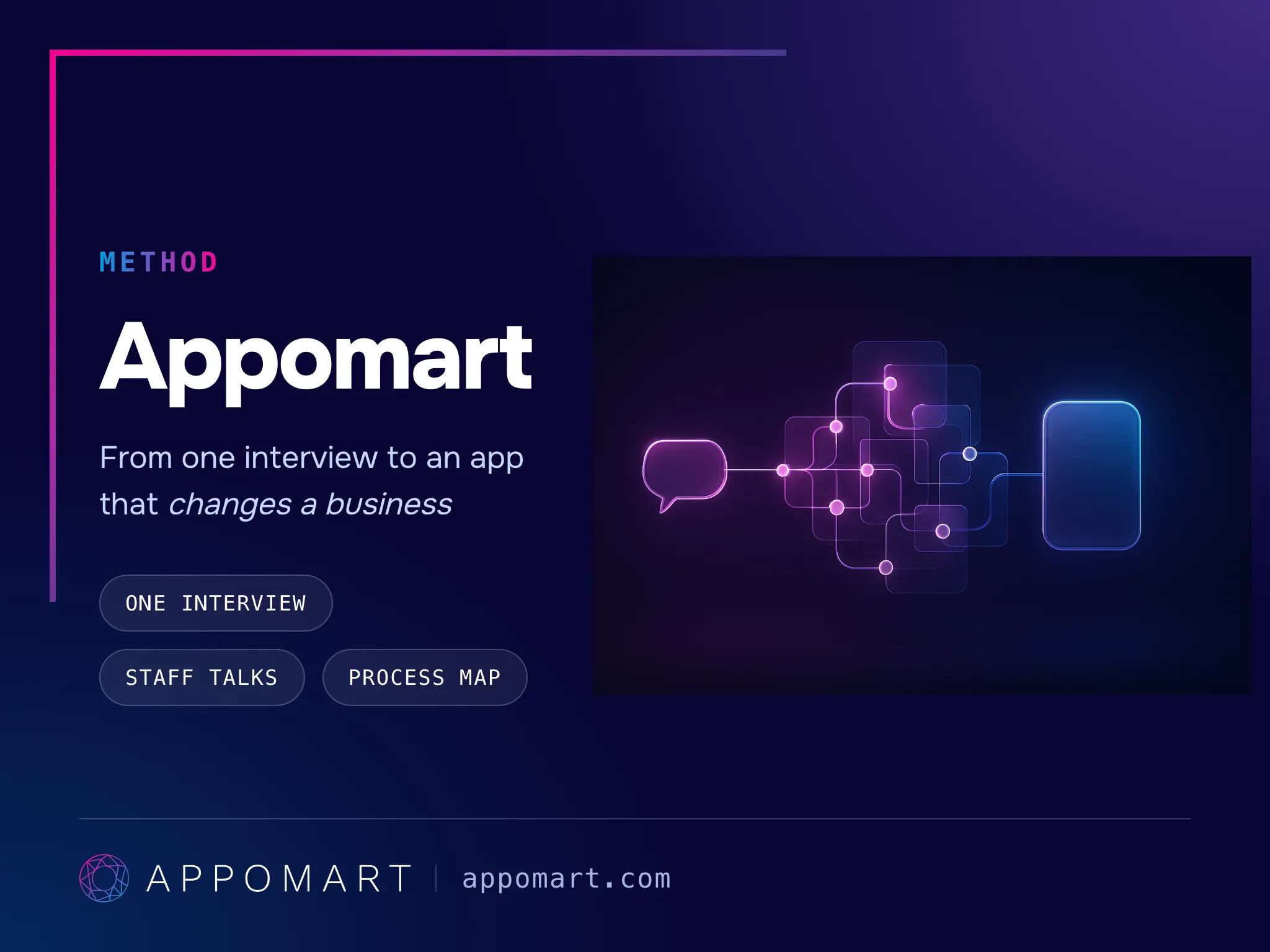
Most software studios start a project with a list of requirements. We start with one interview.
That is not a sales line — it is literally the only brief we ask a business owner for. One conversation, and the rest of the discovery is on us: we go and look, we talk to the people who actually use whatever system is already there, and we come back with a plan before anyone writes a line of code.
The one thing we ask for
A single interview is enough to start, because the interview is not where the real information lives. It lives in the warehouse, at the front desk, in the shared spreadsheet that three people edit at once, in the WhatsApp chat that quietly became the company's actual task tracker. An owner can describe the business. Only a visit shows how it runs.
So after that first conversation, we come to the business and look. We watch the process as it happens, not as the org chart says it should happen, and we talk to the people who do the work every day — not only the owner. A warehouse clerk, a dispatcher, a support operator will tell you, in five minutes, where the process actually breaks. That detail rarely survives translation into a one-page brief.
Writing down what is really happening
What comes out of that visit is a description of the business process as it is actually lived — step by step, exception by exception, including the workarounds everyone uses and nobody wrote down. We call this digitizing the process: turning a way of working that exists in people's heads and habits into something explicit enough to build software around.
Only once that description exists do we talk about what to improve and what to automate — and usually not everything at once. Some steps stay manual on purpose: automating a decision that still needs a human judgment call just moves the same mistake into software. The proposal is specific — this step, done this way, because of what we saw — not a generic checklist of "digital transformation" ideas.
Only then do we design and build the application itself, around the process we have just described, not around a template that happened to be lying around.
Three people feel the difference
A business application has more than one audience, and we think about all three before we draw a single screen.
The owner gets to see the business instead of reconstructing it from phone calls and secondhand reports. Less time spent chasing numbers, less time spent managing by guesswork. Reports arrive in the shape the owner actually reads them in, on the schedule the owner actually wants — not whatever the system happened to be able to export.
The people who use the system every day get something that is comfortable to work with, which means fewer mistakes and less friction in routine tasks.
This is not a nice-to-have. A system that is uncomfortable to use simply does not get used — people route around it, go back to the spreadsheet, keep the WhatsApp chat alive. When that happens, the whole project turns into an expensive showcase: correct in the demo, empty in daily use.
The client's customers — the people who buy from the business, not from us — are the audience that matters most, and the one that is easiest to forget. They do not see the new database schema or the automated step. They see that the business answers faster, makes fewer errors, feels more organized. That change is visible from the outside before it ever shows up in a quarterly report.
What changes afterward
A business that is easier to run, easier to work in, and more consistent to deal with is a more competitive one. Competitors notice before a customer writes a single review about it — and the attentive ones start asking themselves the same questions about their own business that led here in the first place.
We do not have a percentage to put on that, and we are not going to invent one. We have not measured how many hours a specific process saves, because businesses and processes differ enough from one another that a number borrowed from someone else's project would be a guess dressed up as a fact. What we can tell you, in detail, is what happens at each of these steps — the visit, the conversations, the written-down process, the proposal, the build. That part is not a promise. It is simply what we do.
And it still starts the same way it always does: with one interview.